Background
On 7 May 1998, just weeks after the signing of the Belfast/Good Friday Agreement, a delegation from the WAVE Trauma Centre travelled to the White House to meet President Bill Clinton and First Lady Hillary Clinton. Among them was Margaret McKinney, whose son Brian had been abducted, murdered, and secretly buried by the IRA in May 1978.
During the visit, Margaret shared her story with President Clinton, who responded by pledging to do what he could to help recover Brian’s remains.
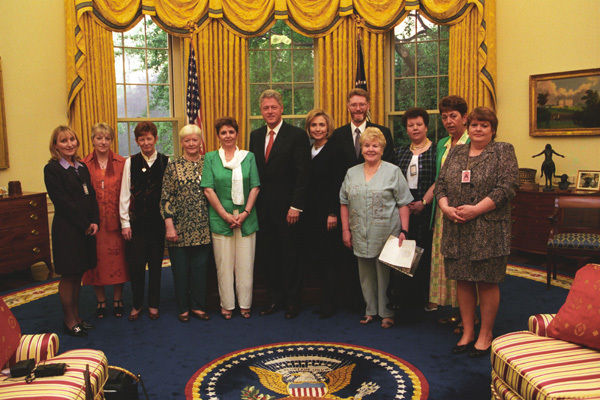
In January 2016, the U.S. State Department released transcripts of phone conversations between President Clinton and UK Prime Minister Tony Blair, revealing a pivotal moment in the days following that meeting. On 8 May 1998, President Clinton told Blair:
“These women gave me an idea yesterday. Your people could vet it for practicality. Maybe you and Bertie [Ahern, Irish Taoiseach] and I could ask for it. They say if there’s not immediate decommissioning right after the vote, if you could work out the legalities so that people would not be prosecuted and the IRA could somehow direct people to the remains, so their families could give them a sanctified burial, that would have a huge psychological impact over there.”
This conversation marked what is widely seen as the genesis of the Independent Commission for the Location of Victims’ Remains (ICLVR).
Legislation
Under a year later —April 1999— legislation was passed in both the UK and Ireland setting up the Independent Commission for the Location of Victims’ Remains (ICLVR). In the UK the relevant law is the Northern Ireland (Location of Victims’ Remains) Act, 1999 while in Ireland the Criminal Justice (Location of Victims’ Remains) Act 1999 applies.
A key feature of the legislation and central to the operation of the ICLVR is the provision that any information that comes to the Commission from whatever source is treated in the strictest confidence and cannot be used for any purpose other than to locate and recover the remains of the Disappeared. It cannot by law form part of any criminal investigation.
Law enforcement authorities cannot have access to information the ICLVR holds and no forensic tests can be carried out on any material found when remains have been located and uncovered.
The ICLVR’s role is exclusively a humanitarian one: it has no political or criminal law function whatsoever.
The remit of the ICLVR is defined in the legislation as covering those people killed before 10 April 1998 (the Belfast/Good Friday Agreement) as a result of actions carried out by a proscribed organisation.